
 2015–2019
The Ask Was a Linter
A case study from Construct, a content platform for more than 30 Ferguson storefronts. Engineering proposed a linter, but the study argues the real problem was bigger: about 40 brand managers were publishing code to 30 storefronts with no review or preview.
Construct, a content platform for 30-plus storefronts · 7 min read
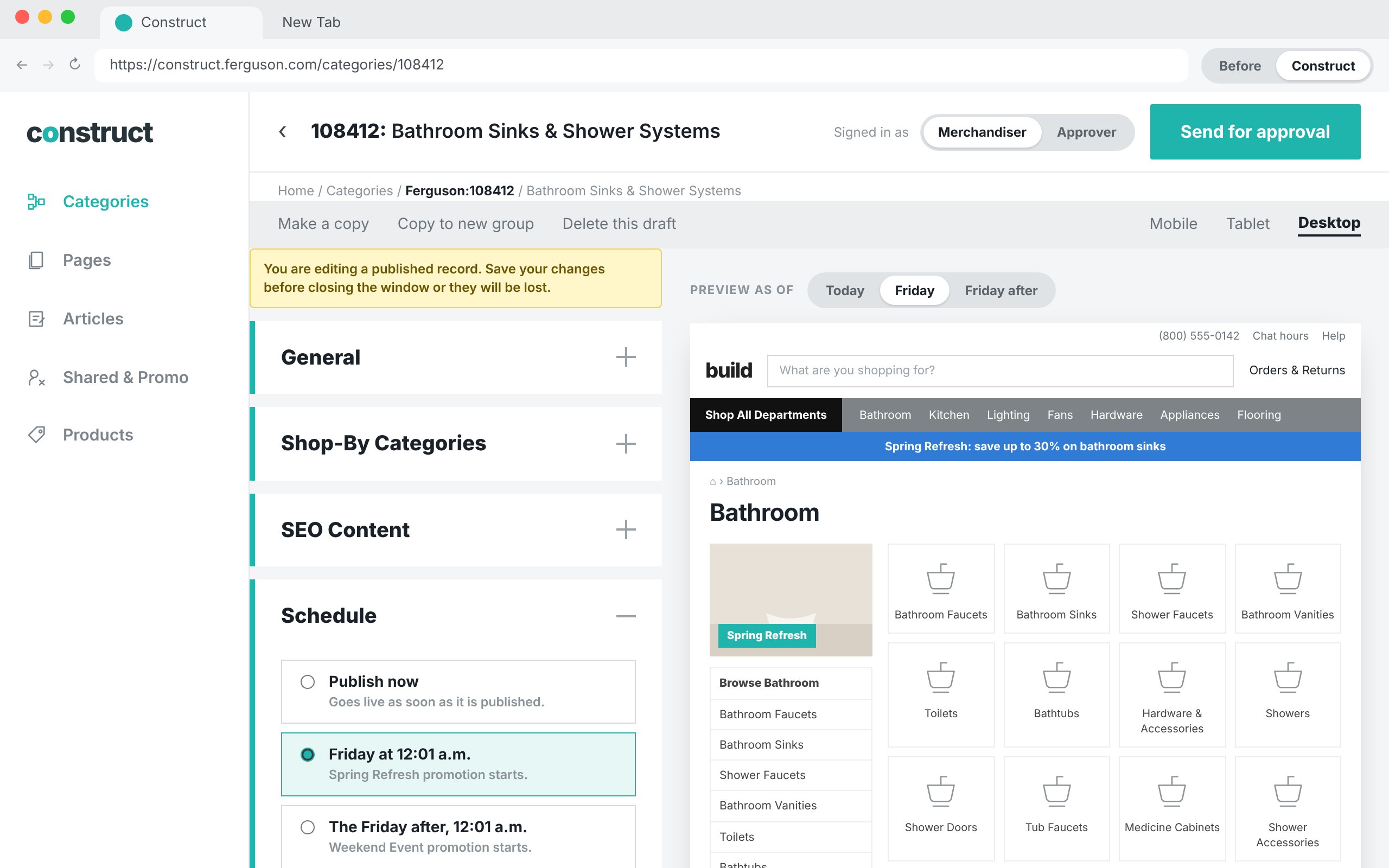
The request that reached me was for a code linter.
Ferguson ran more than thirty storefronts, and every category and landing page on them was put together by a brand manager pasting SQL, HTML, CSS and JavaScript into a box and pressing a button that said "Save code to live site." There was no review step and no preview. Whatever was in the box went to customers the moment it saved. The box would take a stylesheet that recolored the whole page, and it would take a script tag.
Engineering's proposal was reasonable: check the markup before it ships, so broken HTML stops taking pages down. I was the designer and the product manager on the team that owned the tooling, and I thought it would help and wouldn't fix the problem.
What it was costing
I didn't trust my read of it, and neither would anyone with budget, so I worked with finance, HR and merchandising to get numbers they'd each sign off on. About 40 brand managers were merchandising 30 sites by hand.
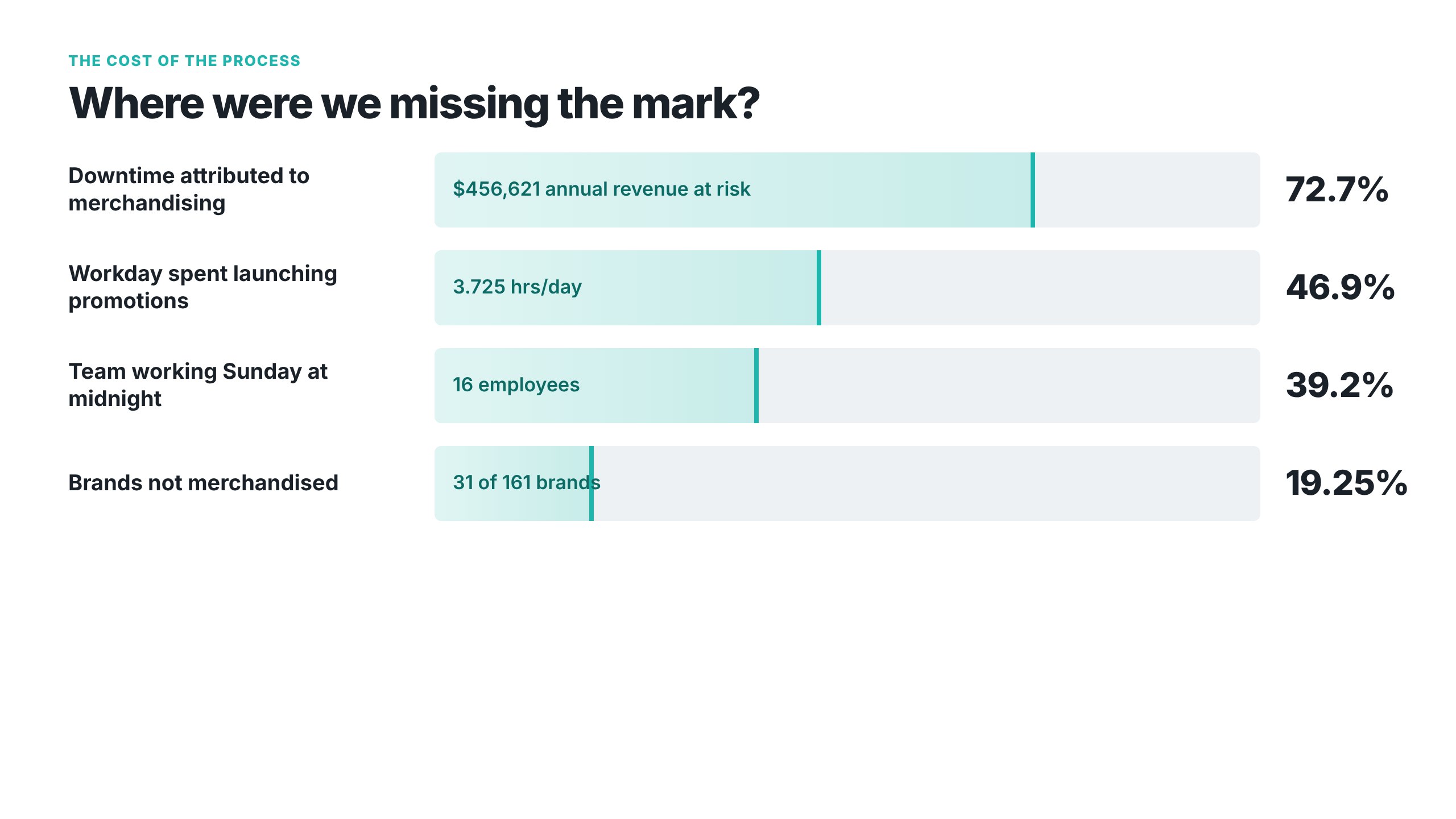
Of the downtime we'd had, 72.7% traced back to merchandising changes, which put about $456,621 a year of revenue at risk. Launching promotions took 46.9% of the workday, roughly 3.7 hours a day. On an average Sunday at midnight, 39.2% of the team was working, which was 16 people. And 31 of our 161 brands, 19.25%, had never been merchandised at all, because nobody had the hours.
We collected the time figures with surveys and time tracking, the dull way. A sticky note on a screenshot of a category page did more work in meetings than the tables did: eight hours to deploy a promotion banner, close to seven for a product grid. People could see which parts of the page were slow, and they could see that the slowness was the process, not the people.
Four groups, four reasonable asks
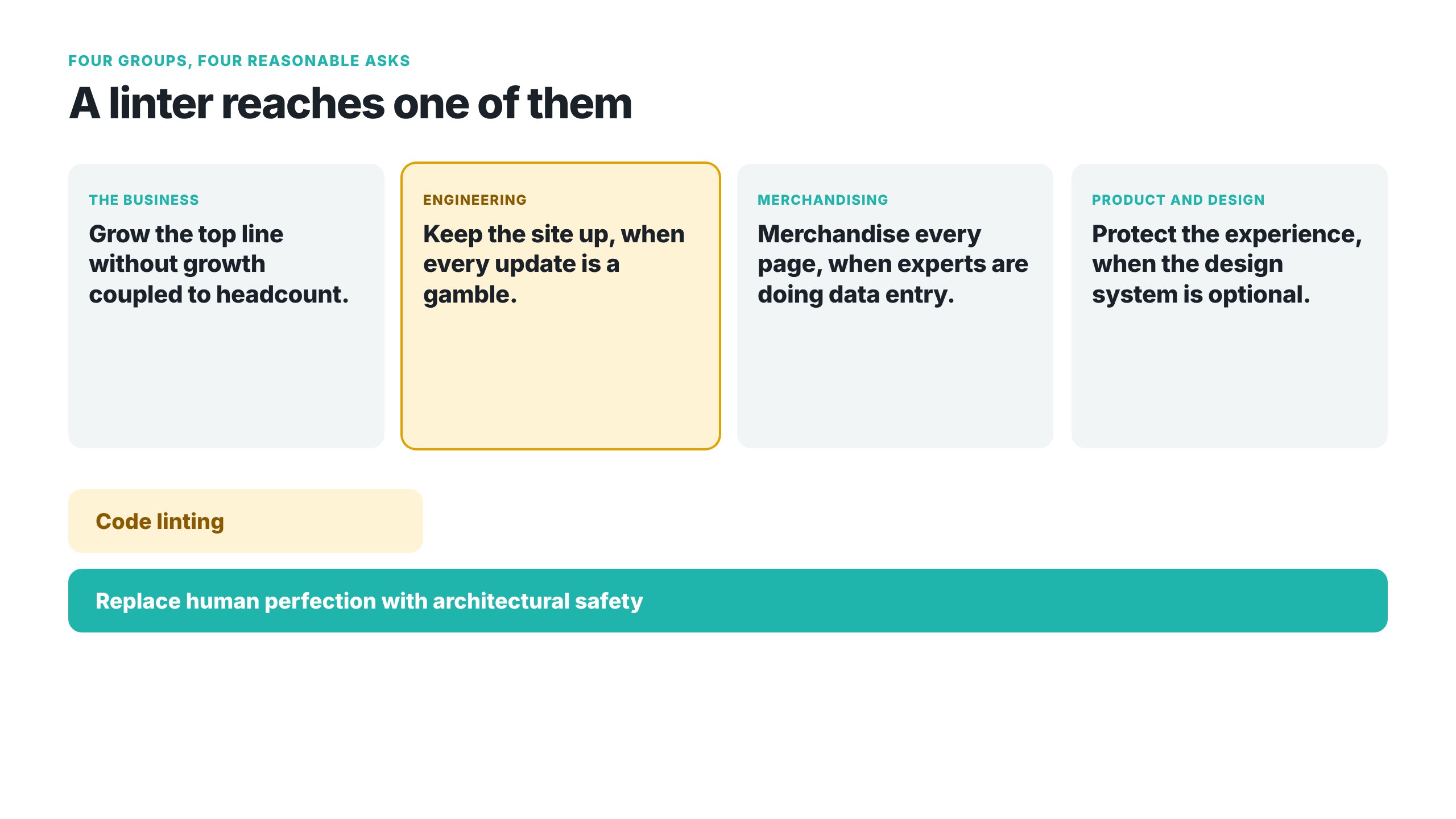
Every group I talked to had a sensible position, and every position pushed against another one. The business wanted top-line growth that wasn't tied to headcount. Merchandising wanted every page merchandised, but its experts were doing data entry. Engineering wanted uptime, and every update was a gamble. Design wanted a consistent experience, and the design system was optional.
That list is how I stopped thinking about a linter. A linter would have served engineering and left the other three where they were. The question underneath was how to replace the need for human perfection with architectural safety, so a business could grow without a risk of collapse that scaled with it.
The pitch
I took two things to leadership, and neither was a mockup first. One was the cost of doing nothing: finance, HR and merchandising had helped me project headcount and brand coverage a few years out under two paths, keep going as we were, or retool. The other was a set of parallel prototypes. A linter and a structured editor look very different on a screen, and putting them next to each other gave a room of executives something to point at instead of something to argue about.
The linter was still in the plan. I made it the first step, and then built the sequence so that every step shipped something small and useful.
Smallest steps that created value
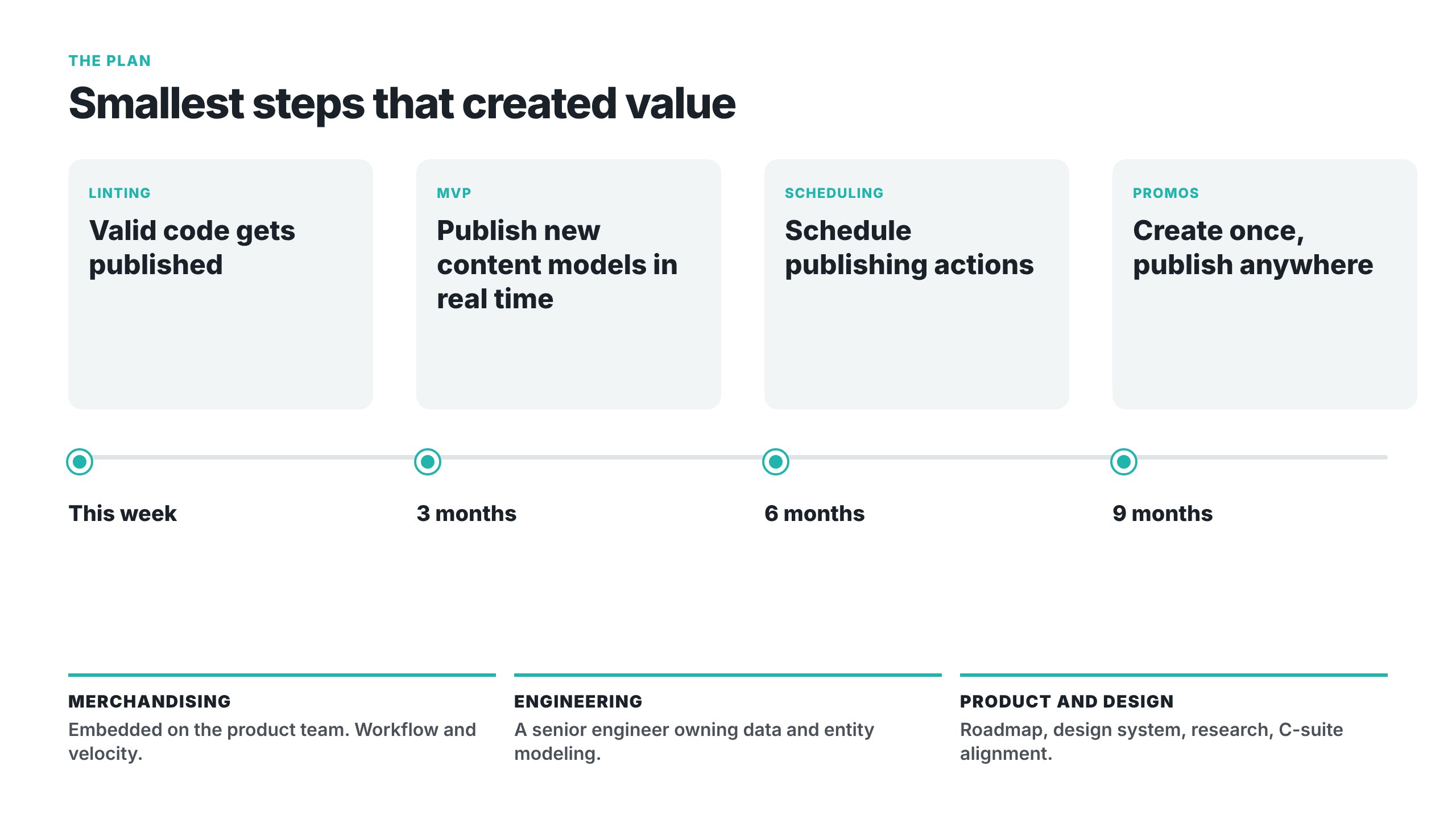
The plan ran about nine months. Linting came in the first week, so valid code was what got published. The MVP came at three months: content models that merchandisers could fill in and publish in real time, instead of writing markup. Scheduling came at six months. Promotions came at nine, with the idea that a promotion could be created once and published anywhere.
The team was built to match. Merchandisers sat on the product team from the start, because the heart of the product was workflow and speed and they were the ones who knew both. I partnered with a senior engineer who owned the data and entity-relationship model, which made the thing buildable from day one. I owned the product vision, the roadmap, the design system, the research and the conversations with the C-suite.
What it looked like
Construct was a structured editor. A page was a set of sections, each with defined places for content, and a preview beside them in mobile, tablet and desktop widths. A merchandiser filled in related brands and articles, picked a hero, set a schedule, and published. Nothing in it accepted a script tag.
The prototype
Three rules held it together. Everything was a reference, never a URL: a shop-by tile pointed at a category and a facet by ID, and the platform built the link when a site asked for it, so a page that moved couldn't leave a dead link behind. Content never said how it would look: a banner had a display variation, "Variation G", instead of "left-aligned on red", so the website, the tablet layout and the native app could each decide what G meant. And the editor wouldn't let you publish a malformed document. If you wrote an h2 and then jumped to an h6 because it was smaller, it told you h2 was your last heading and the next one couldn't go deeper than h3. That was the one place I took a choice away from authors, because proper heading structure was what the SEO work depended on.
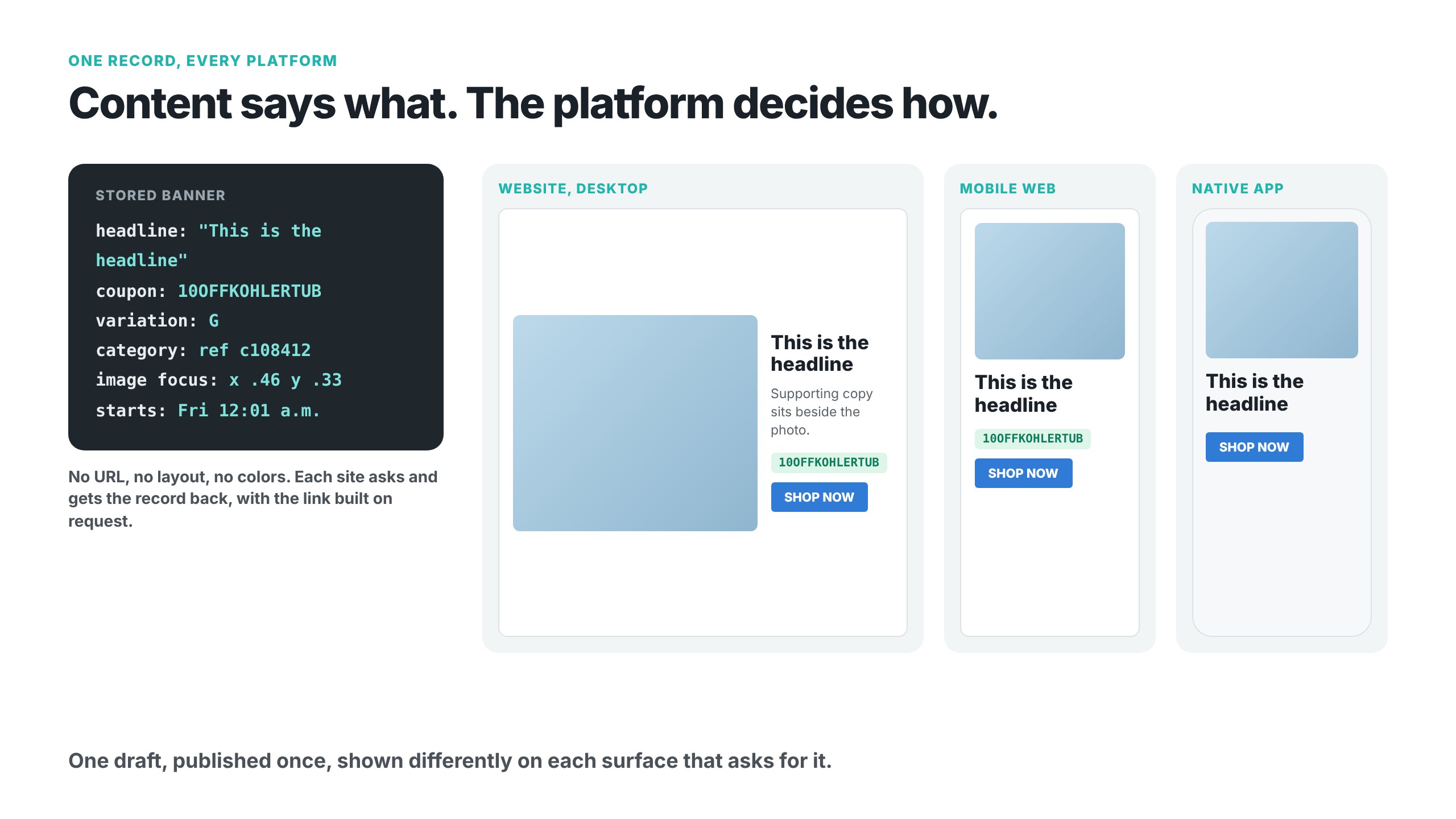
Banners were where this paid off fastest. We had a very small design team and a very large merchandising team, so every promotional banner waited in a ticket queue for a designer. Now a merchandiser filled in a headline, supporting copy, a coupon code, a call to action and a variation, and picked the categories it should appear on across every store. Scheduling worked by overlay. The evergreen banner stayed published, a one-day sale sat on top of it, and the platform returned whichever was published last and went back to the evergreen one when the sale ended. Nobody had to remember to unpublish anything. Merchandisers could keep as many drafts as they wanted, and quick save worked like a document, so a half-finished idea wasn't lost.
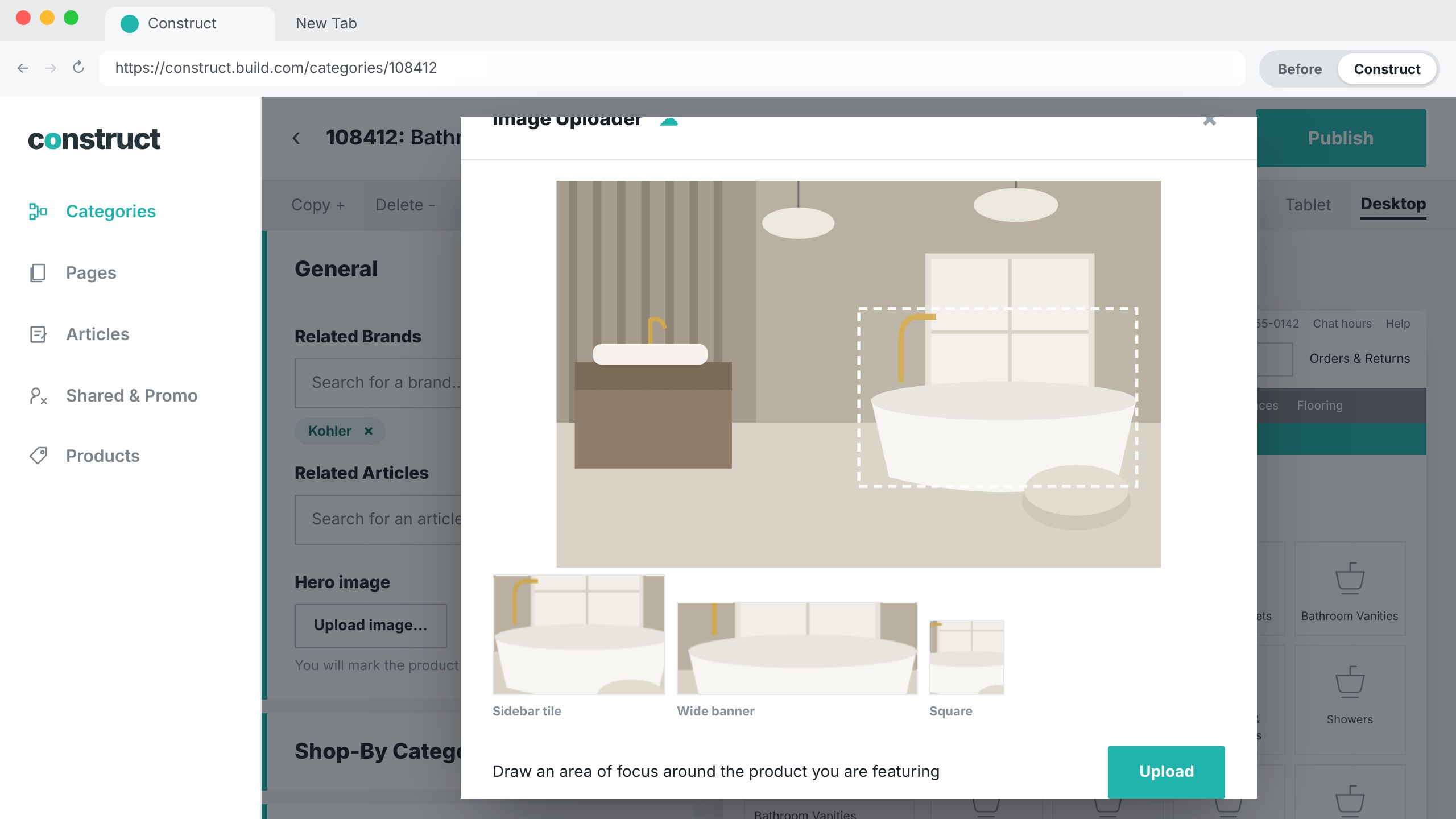
The image uploader was where I spent the most design time, because product photography is where pages quietly go wrong. Instead of cropping and hoping, a merchandiser drew a box around the product in the photo, and the platform kept that area in focus at every size and on every site.
What we got wrong
We were wrong in a different way at each step.
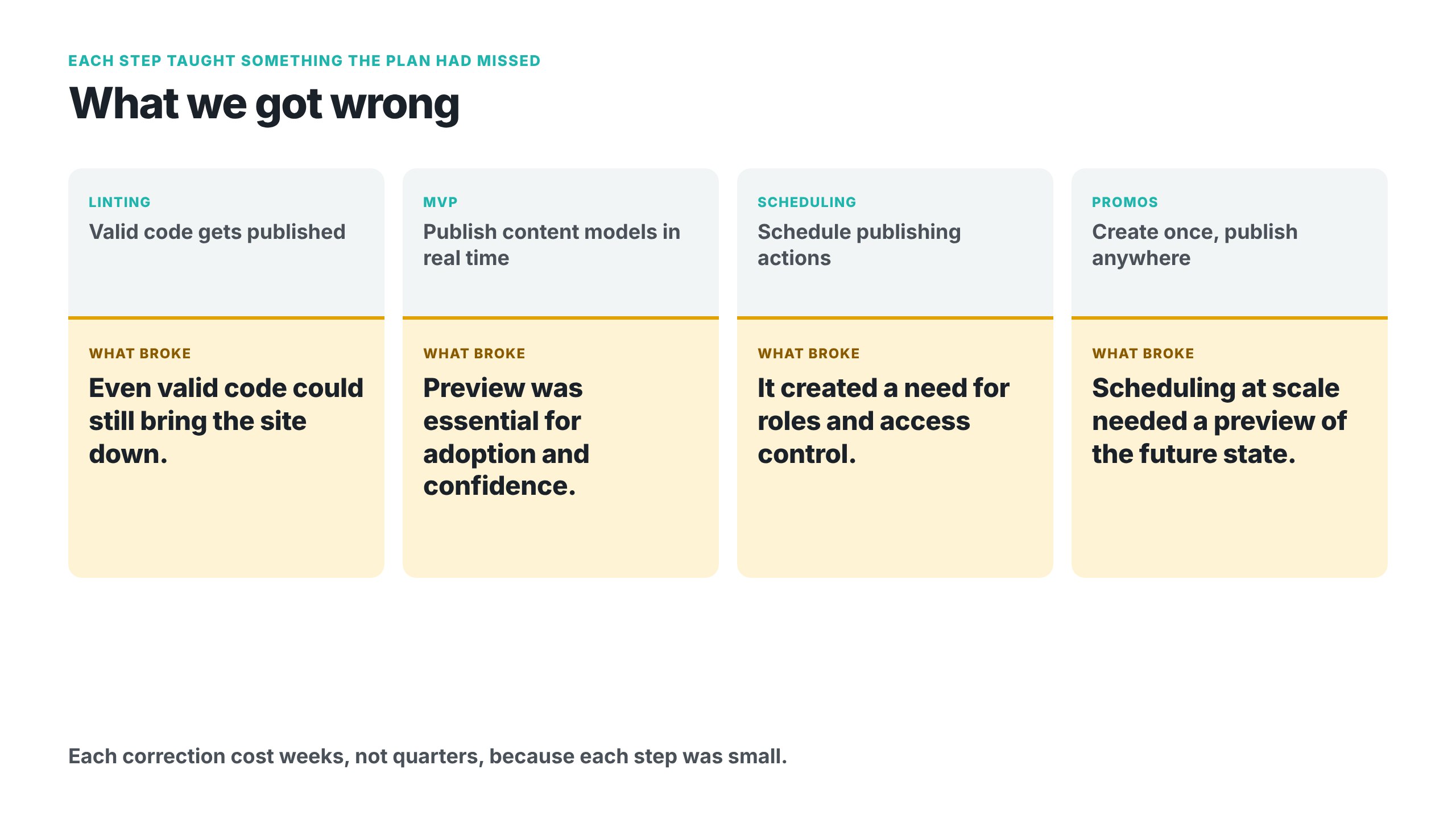
Linting didn't hold the line by itself. Even valid code could still bring a site down. The MVP showed me that preview was the thing people needed in order to trust it, and adoption was slow until they could see the page before it went out. Scheduling created a need for user roles and access control, because publishing for a later date meant someone had to approve what would happen while nobody was watching. And once promotions could be scheduled at scale, people needed to preview a future state of the site, with next Friday's promotion on it and this Friday's still running.
I had planned none of those. Each was a reasonable consequence of the step before it. The sequencing worked because each step was small enough that the correction cost us weeks instead of quarters.
What happened
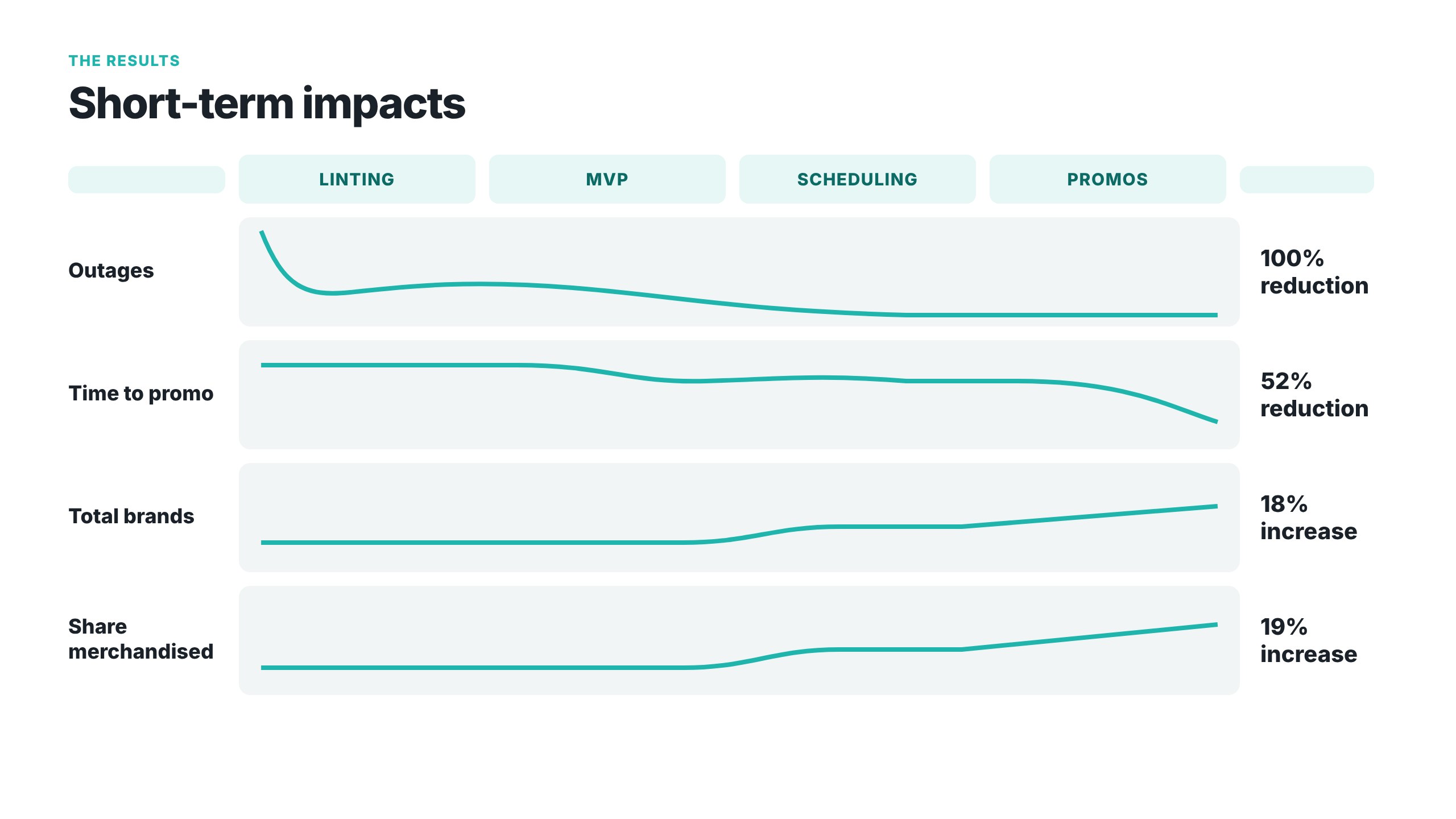
Over the first nine months, outages tied to publishing went to zero. Time to launch a promotion dropped 52%. The number of brands we served grew 18%, and the share of brands that were merchandised rose 19%.
The longer effects surprised me more. A solid content foundation turned out to enable things that weren't on the original list. The business did $1.3 billion in sales the following year, in part because of the efficiency and the newly onboarded brands. The native app would have launched without merchandising, since all of it had been HTML. A new pipeline of AR assets could be created once and used across experiences. And the wider Ferguson organization, a $22 billion business, adopted the platform to run brand experiences, including its own, and still uses it.
Building it with the people who used it
The part of the team I'd repeat is the community. We ran an idea portal where people could submit, debate and vote on ideas in public, which gave me prioritization context I couldn't have got from interviews. I recorded weekly video updates, because people watched video that they skipped as email. And we kept a real-time channel open, in Slack and later elsewhere, because a place where users can talk to you at any hour builds trust and a feeling that it's safe to say something is broken.
What I'd do differently
I'd have put preview and roles in the first plan. They weren't hard to predict. A product that publishes without a preview, or schedules without an approver, has a gap that shows up on the first day. I treated each of them as news when I could have treated them as the next step.
I'd also have kept the cost model alive after the pitch. It got us the approval and then sat in a slide deck, when it could have been the dashboard we watched every month.