
Starting From Zero
A case study on helping start Girls Who Code clubs in Chico, California, and running the DevPOP summer camp. The argument: the first hour, more than the curriculum, decides whether a girl sees herself as someone who does this.
Running Girls Who Code clubs and the DevPOP summer camp in Chico · 4 min read

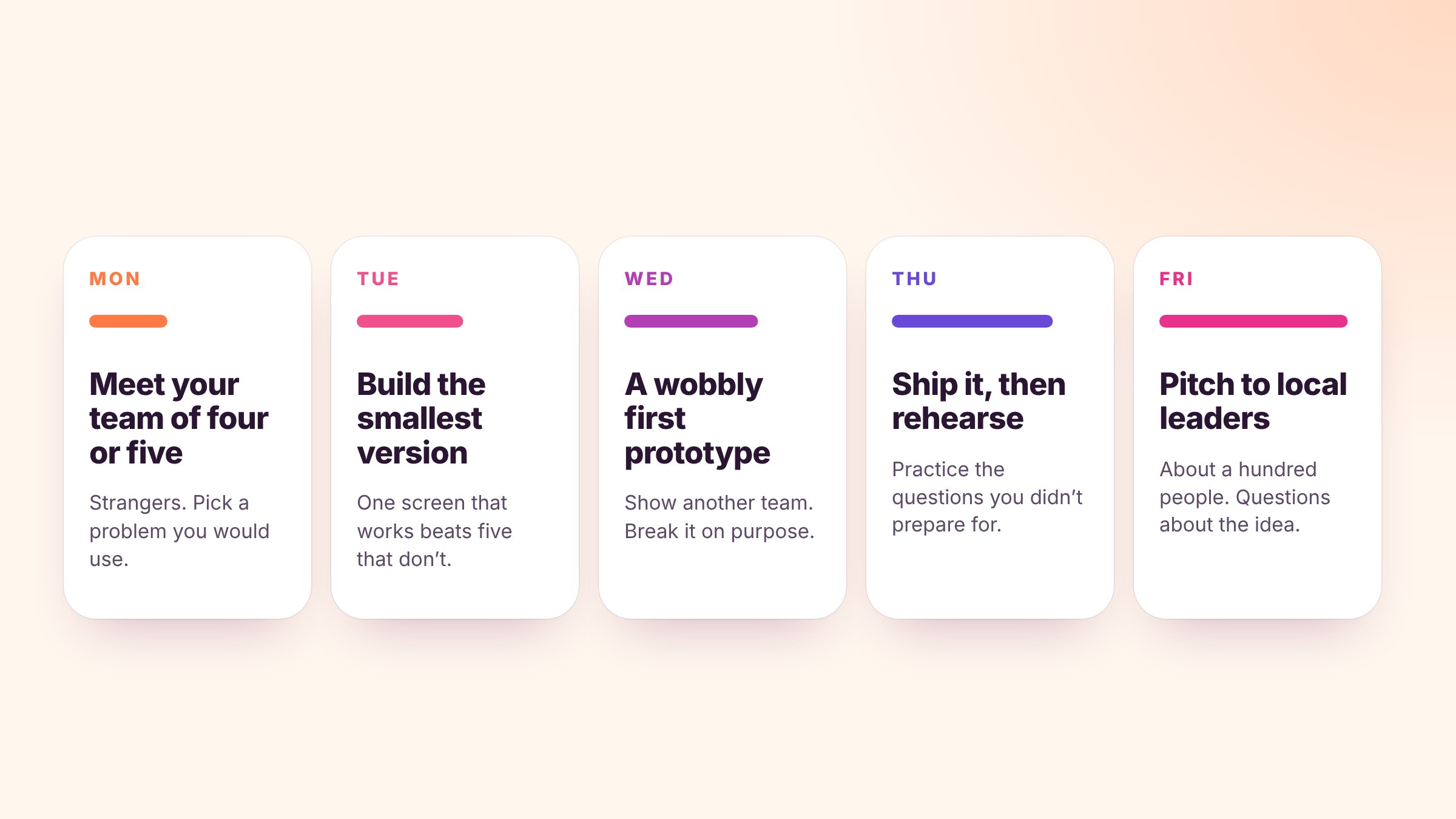
On the last Friday of every camp, about twenty girls pitch an app to a room of local business leaders. On the Monday before, most of them had never met, and some had never written a line of code.
I helped start the Girls Who Code clubs in Chico and ran the summer camp, DevPOP, for years, alongside my work at Ferguson. It's the work I'm quietest about and one of the things I'd defend longest, so here's how it actually went.
The ask
Less than ten percent of the tech community is women, and Ferguson was hiring engineers in a college town with one university and one community college. The company wanted to do something about both. "Run a coding camp" was the easy version of that, and it was also the version most likely to fail: a week of lectures, twenty polite kids, a certificate, and nobody changed.
The reframe
Everyone treats this as a curriculum problem. It isn't. The problem is the first hour. A girl who walks in believing everyone else already knows this decides by mid-morning whether she's a person who does this. If she decides no, nothing we teach on Thursday matters.
So the rule was that we assume they know nothing. No application, no prerequisites, no essay, free. There are already enough barriers for women in tech, and I didn't want to add a gate at the front of our own program.
The second reframe was about the end of the week. A camp that finishes with a demo teaches code. A camp that finishes with a pitch teaches product: who is it for, why would they use it, what happens when someone asks a question you didn't prepare for. I wanted the girls to leave knowing they can make something and defend it.
Decisions
Teams of four or five, formed on Monday, strangers. Some teams take until Wednesday to stop being polite. The upside is that nobody is the one kid who came with her friends, and nobody can hide behind being the only one who knows. Mixed experience is the point, because the girls who already code end up teaching, and teaching is how they find out what they actually understand.
The problem comes from them. Every team picks something they'd use. One built an app that nudges you outside, with suggestions based on the weather. Another built a fantasy game where you resolve conflicts instead of fighting, because they wanted one they'd play. The apps are small and some are wobbly. But a project with a reason to exist gets debugged at 11 a.m. on a Friday without anyone asking.
A pitch in front of about a hundred people. It's modeled loosely on Shark Tank: local women leaders and a full room, a few minutes per team, questions about the idea, not the code. That's a lot for a ten-year-old, and it's why Thursday is rehearsal. Everyone on a team speaks, nobody is alone up there, and a bad answer is survivable because the whole team is standing behind it. One girl told us afterward that she'd tried something she never would have, and that it made her want to try something new again. That's the program's output.
Coaches who answer with questions. Each team worked with a product manager from a tech company around town, who donated their time, plus Chico State students and a community college instructor. Product managers were the right call because the girls were building products, not just code. The rule was that a coach never touches the keyboard. On the last day one team's Chromebook screens started cycling through colors. Before a coach reached the table, an eleven-year-old on the team had worked out why and fixed it. I think about that more than any slide I've made.
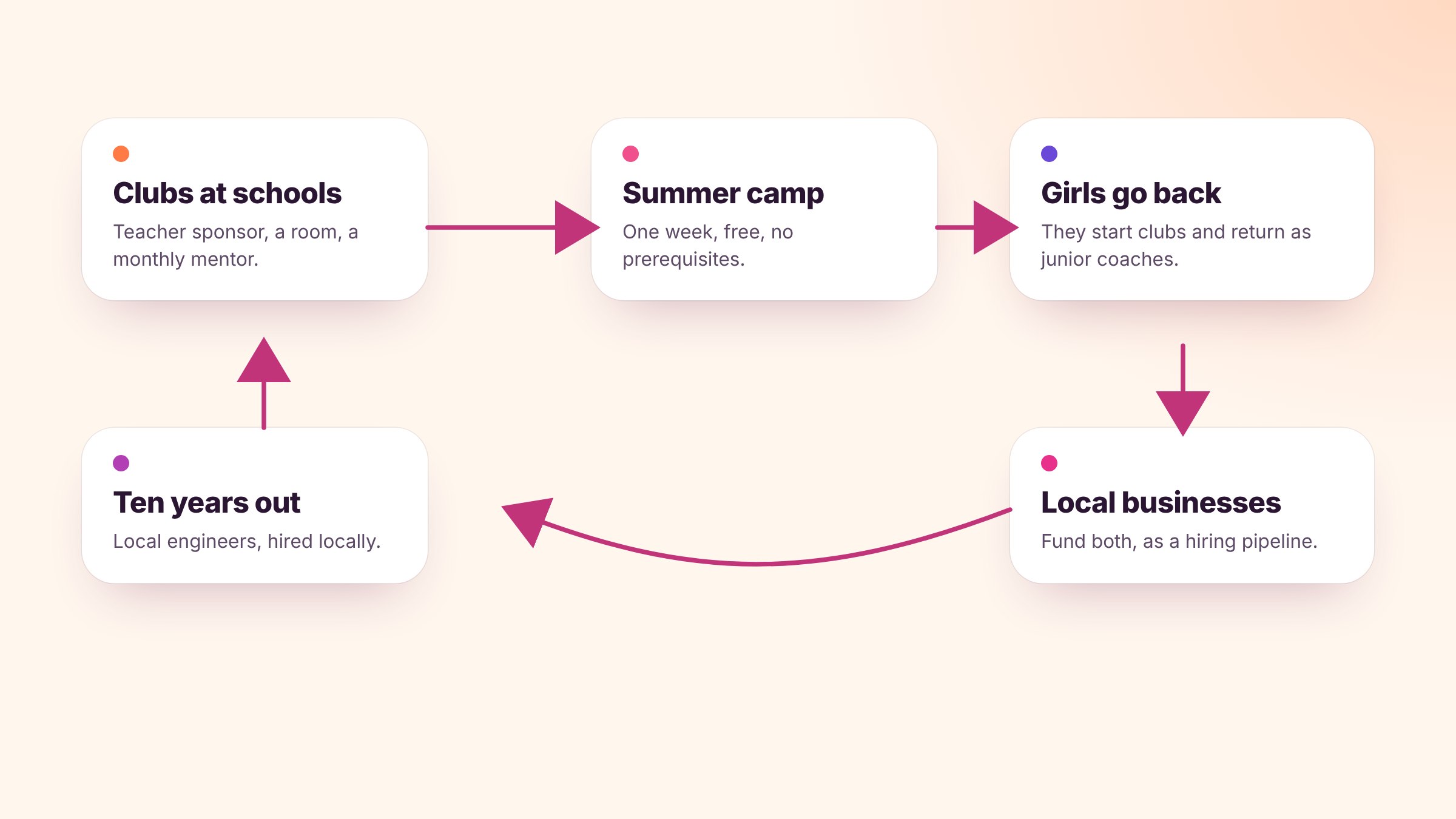
Clubs and camp feed each other. The school clubs run all year, each with a teacher sponsor and a room, and we supplied a curriculum and a mentor who visited monthly. Girls come to camp from clubs, and girls go back to start one. The camp is the loud week; the clubs are the reason anyone returns.
Local businesses pay for it and tell us what they need. I never pitched it as charity. I pitched it as hiring: these are employees ten years from now, and a town that grows its own engineers has an easier time hiring them. It's also a feedback loop: companies say what they're looking for, and we build what's current into the curriculum. That's why the format changes every year, a video game one summer and a mobile app the next. That framing got sponsors to say yes faster than the feel-good version did, and it kept the program from depending on one company's mood.
What went wrong
The first camp front-loaded instruction. By Wednesday the room was quiet in the wrong way, and the girls weren't absorbing it, they were waiting it out. We cut lecture to under an hour a day and moved everything else to building. Noise became the signal that it was working. By Friday it's louder, sillier and messier, and I've stopped apologizing for that. It also has to stay summer camp: food, backpacks, canteens, shirts, bounce houses. Nobody builds an app on a bad Tuesday if lunch is late.
What it added up to
About twenty girls a summer, a few clubs running at any time, and several girls who went home from camp and started a club at their own school. I won't claim more than that. The point of the program is ten years out, and I only have a few of those years.
What I'd do differently
Track alumni from the first summer. We had stories and a few photos and no list, so I can say what the week felt like but not what happened to the girls after it. I'd also pay the junior coaches, the girls who come back as helpers, because they're the most convincing people in the room and we treated them as volunteers.